.png)
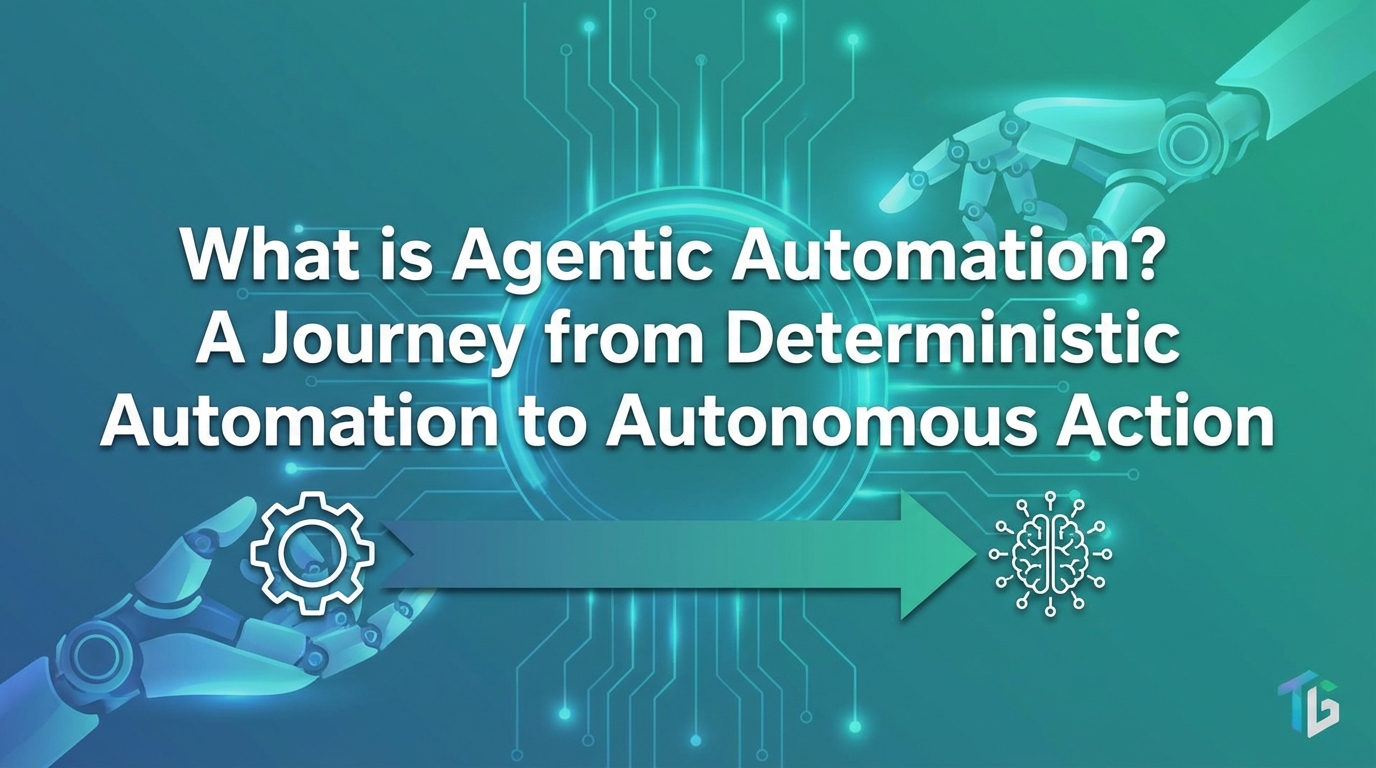
Agentic automation represents the next evolution of enterprise automation, moving beyond rigid, deterministic workflows to systems powered by AI agents that can reason, adapt, and dynamically decide actions. Traditional deterministic automation follows predefined rules and sequences, making it effective for predictable processes but limited in handling changing contexts. Agentic automation introduces intelligent agents that evaluate situations, coordinate tasks, and adjust workflows in real time to achieve outcomes. Rather than replacing deterministic automation, most enterprises will adopt a hybrid model that combines structured workflows with autonomous AI agents for greater flexibility and efficiency.
Introduction
Automation has been one of the most powerful forces shaping modern enterprise operations. Over the last two decades, organizations have steadily automated repetitive work across IT, HR, finance, and customer support. This shift has helped businesses increase efficiency, reduce human error, and scale operations without dramatically increasing headcount.
Yet the type of automation that most enterprises rely on today follows a predictable model. For the last 10 to 20 years, automation has largely been deterministic. Deterministic automation follows a predefined sequence of steps designed by engineers and process architects. Once triggered, the automation simply executes those steps in order.
A useful way to visualize deterministic automation is through a simple metaphor: a row of dominoes. When the first domino falls, it knocks over the next one, then the next, and so on. The entire sequence unfolds exactly as it was arranged beforehand.
Traditional automation systems operate in a similar way. Once the first step begins, the workflow moves from step to step until the process reaches its conclusion.
This model has delivered tremendous value across enterprises. However, a new model of automation is beginning to emerge. Instead of rigid sequences of instructions, organizations are exploring agentic automation, where software agents can evaluate context, reason about situations, and dynamically decide what to do next.
Understanding the difference between deterministic automation and agentic automation is becoming increasingly important as enterprises adopt AI-driven operations. While deterministic automation remains foundational, agentic automation represents the next stage in the evolution of enterprise automation.
What Is Deterministic Automation?
Deterministic automation refers to automation systems that follow a predefined workflow with clearly defined steps. Every action the system performs has been designed ahead of time, and the system executes those instructions exactly as programmed.
At its core, deterministic automation is built around three fundamental characteristics.
Predefined Workflows
The most important feature of deterministic automation is that workflows are created in advance. Engineers define a process with a fixed sequence of tasks.
A typical workflow might look like this:
Once triggered, the automation executes each step in order.
Rules-Based Logic
Deterministic automation systems also rely heavily on rules-based decision making. These decisions are typically expressed as if-then logic.
For example:
· If a request is approved, continue to the next step.
· If the request is rejected, notify the requester.
· If the data validation fails, escalate to support staff.
Although deterministic workflows may contain many branches, every branch is still predefined.
Decision Trees Instead of Reasoning
Most deterministic automations operate through decision trees. The system evaluates conditions and follows the appropriate path.
This approach works extremely well for structured business processes where:
· The rules are clearly defined
· The possible outcomes are known
· The process rarely changes
Example: Employee Onboarding with Deterministic Automation
Employee onboarding is one of the most common enterprise automation scenarios. Many organizations automate the onboarding process to reduce manual coordination between HR, IT, and management teams.
A deterministic onboarding workflow might look like this:
1. HR enters the new employee information into the system
2. The automation requests approval from the hiring manager
3. Once approved, the system creates employee accounts
4. IT provisions a laptop and system access
5. Training materials are assigned to the new employee
6. Welcome emails are sent automatically
Each of these steps occurs in sequence. If any conditions exist, they are predefined within the workflow.
For example:
· If the employee is in engineering, assign developer tools
· If the employee is in finance, assign accounting systems
The automation does exactly what it was designed to do. Nothing more and nothing less.
The Key Limitation of Deterministic Automation
Deterministic automation is powerful, but it has a fundamental limitation. It cannot reason about changing conditions.
The system does not evaluate new situations or adapt its behavior unless those possibilities were designed in advance.
In other words, deterministic automation always executes what was defined earlier. It cannot rethink the workflow in response to new context.
Imagine a scenario where a new employee is scheduled to join the company in two days rather than the usual two weeks. Perhaps the employee is a senior executive or a critical hire who must begin immediately.
A deterministic automation will still follow the same sequence:
1. Approval request
2. Account creation
3. Asset provisioning
4. Training assignment
It does not recognize urgency. It does not prioritize tasks differently. It simply follows the script.
This limitation becomes increasingly important as enterprise processes grow more complex and dynamic.
However, it is important to emphasize that deterministic automation still provides enormous value. Many enterprise workflows are predictable and structured. For these processes, deterministic automation remains extremely effective.
In fact, deterministic automation can handle highly complex workflows involving dozens of systems, multiple approvals, and intricate data processing. Therefore, it is here to stay, but not rule the automation domain anymore.
What Is Agentic Automation?
Agentic automation introduces a new concept into enterprise automation: software agents that can reason about problems and decide what to do next.
Rather than executing a rigid workflow, agentic automation systems evaluate context, analyze available information, and dynamically choose the next step required to achieve a goal.
This shift moves automation from simple task execution to intelligent orchestration.
Agentic automation systems typically rely on AI-powered agents capable of:
· Interpreting instructions
· Evaluating contextual data
· Selecting actions from available tools
· Coordinating with other agents
These agents behave less like static scripts and more like problem-solving assistants.
How Agentic Automation Differs from Traditional Automation?
The difference between deterministic automation and agentic automation becomes clearer when viewed across several dimensions.
Agentic automation systems focus on outcomes rather than sequences. The system understands the objective and determines the best way to achieve it.
Example: Agentic Automation in Employee Onboarding
To understand how agentic automation works in practice, consider the same employee onboarding scenario discussed earlier.
In a traditional deterministic system, onboarding follows a fixed set of steps. In an agentic system, the workflow can adapt dynamically based on context.
Imagine the system detects that the employee is joining in two days instead of the usual eleven.
An agentic automation system could respond by:
· Expediting laptop procurement
· Escalating approval requests to managers
· Running account creation tasks immediately
· Notifying relevant teams of the urgent timeline
· Triggering parallel workflows across multiple systems
Instead of waiting for each step to complete sequentially, the system can execute multiple tasks simultaneously.
For example:
Each agent contributes to the overall goal of preparing the employee for their first day.
The most important aspect is that the system can re-evaluate the situation after each step. If new information appears, the workflow can adapt accordingly.
Question 1: Will Deterministic Automation Disappear?
As agentic automation becomes more popular, many organizations wonder whether deterministic automation will eventually disappear.
The answer is clearly no.
Deterministic automation continues to serve many critical enterprise functions. In fact, there are many situations where deterministic automation remains the preferred approach.
Deterministic automation works best when processes are predictable and well structured.
Examples include:
· Compliance reporting workflows
· Financial reconciliation processes
· Data synchronization between systems
· Structured approval chains
In these scenarios, strict sequencing and predictability are essential. Organizations often require clear audit trails and consistent execution.
Deterministic automation provides exactly that.
A useful rule of thumb is that deterministic automation should be used when:
· The process is predictable
· The sequence of steps is known
· No reasoning is required
Agentic automation should be introduced when workflows become too complex to define in advance.
Rather than replacing deterministic automation, agentic automation augments it.
Most modern automation architectures will include both approaches.
Question 2: Are Agentic Automations Risky?
Another common concern about agentic automation involves risk and control.
If AI agents can make decisions autonomously, how do organizations ensure they behave responsibly?
These concerns usually fall into three categories.
Lack of Control
Organizations worry that autonomous agents might take unexpected actions. If the system can make decisions, what prevents it from making the wrong ones?
AI Autonomy
Some leaders fear that giving automation systems decision-making capability might reduce oversight.
Hallucinationsand Incorrect Reasoning
Because agentic systems often rely on AI models, there is concern about incorrect interpretations or hallucinated outputs.
These risks are addressed through architectured guardrails at the enterprise level.
Guardrails That Control Agentic Automation
Modern agentic automation systems operate within clearly defined boundaries. Agents do not have unlimited freedom. Instead, they interact only with tools and resources that administrators explicitly allow.
Typical safeguards include:
· Agents can access only predefined tools and APIs
· Actions are limited to specific capabilities
· Security permissions restrict system access
· Prompts guide agent behavior
For example, an agent responsible for onboarding employees might have access to:
· HR system APIs
· Identity management tools
· IT asset management systems
The agent can choose how to use these tools, but it cannot create entirely new capabilities. This ensures that automation remains both intelligent and controlled.
Enterprise Agentic AI tools like Rezolve.ai ensure architectural guardrails for implementing it across any scale, and offer more security and transparency in how AI is being utilized within a company.
Rezolve.ai and the Future of Hybrid Automation
As enterprises explore both deterministic and agentic automation, platforms that support both models simultaneously will become increasingly valuable. Rezolve.ai combines traditional automation with modern AI-driven workflows.
The platform enables organizations to build structured workflows while also deploying intelligent agents capable of dynamic decision making. Two core capabilities define the platform’s approach.
AI-Assisted Deterministic Automation
Traditional workflow automation can be time consuming to design. Rezolve.ai simplifies this process with AI-assisted automation builders.
These tools help organizations create deterministic workflows faster by:
· Automatically generating workflow logic
· Suggesting automation steps
· Accelerating testing and deployment
This allows companies to continue benefiting from deterministic automation while reducing development time.
Agentic Studio for Autonomous Workflows
Rezolve.ai also provides Agentic Studio, an environment where organizations can build and orchestrate teams of AI agents.
Within Agentic Studio, enterprises can design workflows where agents collaborate to solve problems rather than follow rigid instructions.
Agents can perform tasks such as:
· Retrieving information from enterprise systems
· Executing automation scripts
· Coordinating tasks across teams
· Responding to employee requests
Multiple agents can work together within a single process.
For example, in an IT service request scenario:
This architecture allows organizations to automate complex processes that traditional workflows cannot easily handle.
Rezolve.ai supports both deterministic and agentic automation within a single platform. This hybrid approach allows enterprises to gradually evolve their automation strategies rather than replacing existing systems entirely.
The platform also includes visual tools such as AI Flow Builder and Agentic Studio interfaces, which help teams design automation without extensive coding.
Organizations exploring similar hybrid automation approaches may also look at platforms such as n8n, which supports both workflow automation and agent-based automation.
However, the broader industry trend is clear. Enterprise automation is moving toward systems that combine structured workflows with intelligent agents.
Rezolve.ai Agentic Studio for Creating Agentic AI Automation and Workflows
Static workflows and rigid scripts are no longer enough to handle the dynamic complexity of modern IT and business environments. This is where Rezolve.ai’s Agentic Studio comes into play.
Agentic Studio is the development and orchestration environment within Rezolve.ai that enables organizations to create, manage, and deploy AI agents and multi-agent teams capable of automating real business processes. Instead of designing rigid automation flows, teams can build intelligent systems that reason about tasks, collaborate across agents, and execute workflows dynamically.
The platform is designed to make advanced AI automation accessible to both developers and operational teams. Through a combination of visual tools, configuration panels, and centralized monitoring dashboards, Agentic Studio provides everything needed to move from simple automation to fully autonomous operations.
.png)
A Centralized Environment for Agent Development
At its core, Agentic Studio functions as a centralized workspace where organizations can create and manage AI agents. When users first enter the platform, they are presented with a simple interface that asks a straightforward question:
“What would you like to build?”
From this starting point, users can create:
· Individual AI agents
· Multi-agent teams
· Agent workflows and automations
The platform allows users to either manually configure agents or describe what they want to build and let AI assist in generating the structure. This dramatically reduces the time required to deploy new automation capabilities.
Instead of spending weeks coding workflows, teams can rapidly define objectives and allow the platform to scaffold the agent architecture.
Building Individual AI Agents
Within Agentic Studio, the fundamental building block of automation is the AI agent.
Agents are intelligent software components that can perform tasks such as:
· Interacting with users through conversations
· Retrieving knowledge from enterprise systems
· Executing workflows or scripts
· Coordinating actions across platforms
The Agents section of the interface allows administrators to create and manage these individual agents. From this area, users can define agent capabilities, configure prompts or instructions, and connect agents to enterprise tools or data sources.
Each agent operates with a specific role. For example, one agent may specialize in knowledge retrieval while another focuses on executing workflow actions.
By separating responsibilities in this way, organizations can design systems where agents collaborate to solve complex problems.
.png)
Creating Multi-Agent Teams
While individual agents can perform specific tasks, the real power of Agentic Studio emerges when multiple agents are combined into agent teams.
.png)
The Agent Teams module allows users to create groups of agents that work together to accomplish broader objectives. These teams function similarly to human teams inside an organization. Each agent contributes to its specialized capabilities to complete a process.
This team-based architecture enables Rezolve.ai users to automate entire workflows rather than isolated steps.
If You Can Think It, You Can Automate It: AI-Assisted Agent Creation
One of the most powerful capabilities within Agentic Studio is the ability to create agents using natural language instructions.
Users can simply describe the automation they want to build. The system then generates the agent structure, including the tasks and interactions required to complete the workflow.
.png)
This approach significantly reduces the technical barrier to entry. Instead of requiring extensive development expertise, operational teams can quickly prototype and deploy new automation ideas.
For organizations experimenting with AI automation, this feature accelerates innovation while maintaining control over system behavior.
Monitoring and Analytics Through the Dashboard
Once agents and workflows are deployed, it becomes critical to track how they perform. Agentic Studio includes a comprehensive dashboard that provides real-time visibility into automation activity.
.png)
The dashboard displays key metrics such as:
· Total number of agents deployed
· Agent interactions with users
· Workflow executions
· Success and failure rates
· Pending tasks requiring human intervention
These insights allow organizations to evaluate the effectiveness of their automation initiatives and quickly identify areas where processes can be improved.
For example, if a workflow shows a high failure rate, administrators can investigate the root cause and refine the automation logic.
The dashboard also provides visibility into agent team runs, helping organizations understand how multi-agent workflows perform over time.
Configuring AI Models
Another critical component of Agentic Studio is the ability to configure the AI models that power the agents.
.jpg)
Through the AI Models settings panel, administrators can select which language models are available to agents and define default model configurations.
Organizations can connect to external AI providers such as OpenAI or other model vendors through API keys. Once connected, these models can be assigned to agents depending on the complexity of the tasks they must perform.
Workflow Execution and Automation Tracking
Agentic Studio also provides detailed monitoring for workflow executions and agent runs.
The system tracks:
· Total workflow executions
· Successful runs
· Failed executions
· Active processes
· Queued tasks
These metrics help teams maintain operational visibility across their automation environment.
For enterprises running large numbers of automated processes, this level of monitoring is essential. It ensures that automation systems remain reliable and scalable as adoption grows.
Integrations and Extensibility
Modern automation platforms must integrate with a wide range of enterprise tools. Agentic Studio includes an integration layer via the MCP Hub that allows agents to interact with external systems.
.png)
The platform provides connectors for:
· APIs
· enterprise knowledge bases
· workflow triggers
· external services
Through these integrations, agents can retrieve information, execute actions, and coordinate across multiple systems.
Human Collaboration and Oversight
Despite the autonomous capabilities of AI agents, enterprise automation still requires human oversight in many scenarios.
.png)
Agentic Studio includes a Human Collaboration section that tracks situations where human approval or intervention is needed.
Examples include:
· Sensitive workflow actions that require approval
· Exceptions that agents cannot resolve automatically
· Escalations from automated processes
By integrating human review directly into the platform, organizations can safely deploy AI-driven automation without sacrificing governance or compliance.
Enabling the Future of Enterprise Automation
Rezolve.ai’s Agentic Studio is designed for a future where enterprise automation becomes increasingly intelligent and adaptive.
By combining agent creation, multi-agent collaboration, AI model configuration, workflow monitoring, and human oversight into a single platform, Agentic Studio provides the foundation for next-generation automation systems.
In Closing
When it comes to deterministic automation vs agentic AI automation, the difference in capabilities is clear. However, one is not a simple replacement for the other. In fact, both these automation types are well-suited for different enterprise applications and operational niches.
That said, deterministic automation is here to stay for the long haul, and Agentic AI automation is here to rule everyday enterprise operations.
See what Rezolve.ai and its advanced Agentic AI capabilities do for your enterprise efficiency and productivity with proven ROI – Book a Demo


.webp)

.png)










.webp)