

Artificial intelligence is evolving rapidly, and the latest advancement—Agentic AI—represents a fundamental shift in how AI systems operate. Unlike traditional AI that relies heavily on human instructions for every step, Agentic AI is autonomous, capable of making predictions and decisions independently, setting its own goals based on simple user instructions, and occasionally checking in to ensure everything is progressing correctly.
This modern form of AI better mimics the human brain's decision-making processes. It can handle higher-level, complex tasks such as booking flights, planning events, building applications from scratch, and managing multi-step workflows. These tasks require planning, adaptation to new situations, and decision-making—all of which Agentic AI can accomplish with minimal human intervention. Agentic AI pilot studies show that 70–85% of multi-step workflows can be completed without human intervention (source: Mukherjee & Chang, 2025)
The result? Life becomes significantly easier for individuals and organizations. Tedious, time-consuming tasks that once required constant human oversight can now be delegated to AI assistants that work autonomously. However, users should still check in periodically to ensure tasks are being executed correctly and catch any potential errors. While Agentic AI is highly capable, it can make mistakes just like humans, making oversight essential.
What is Agentic AI?
Agentic AI is an autonomous form of artificial intelligence that can make its own decisions, set goals, and adapt to new situations with minimal human input. Unlike Generative AI—which depends entirely on prompts—Agentic AI acts on intent, plans tasks, and adjusts in real time.
Agentic AI is autonomous AI that plans, decides, and executes tasks with minimal human oversight—unlike Generative AI, which simply follows instructions.
Agentic AI vs. Generative AI: Understanding the Difference
While both Agentic AI and Generative AI are powerful technologies, they serve fundamentally different purposes and operate in distinct ways.
Generative AI functions based solely on user instructions and performs tasks that don't involve complex processing or autonomous decision-making. When using Generative AI, users provide prompts, and the AI executes exactly what's requested without independent thinking. This requires constant human oversight to ensure the AI isn't misinterpreting instructions. Clear, concise directions are essential to avoid ambiguity.
Agentic AI, in contrast, can perform intricate tasks with far less user intervention. It dynamically interacts with its environment, adapts based on real-time feedback, and makes decisions to achieve specific goals.
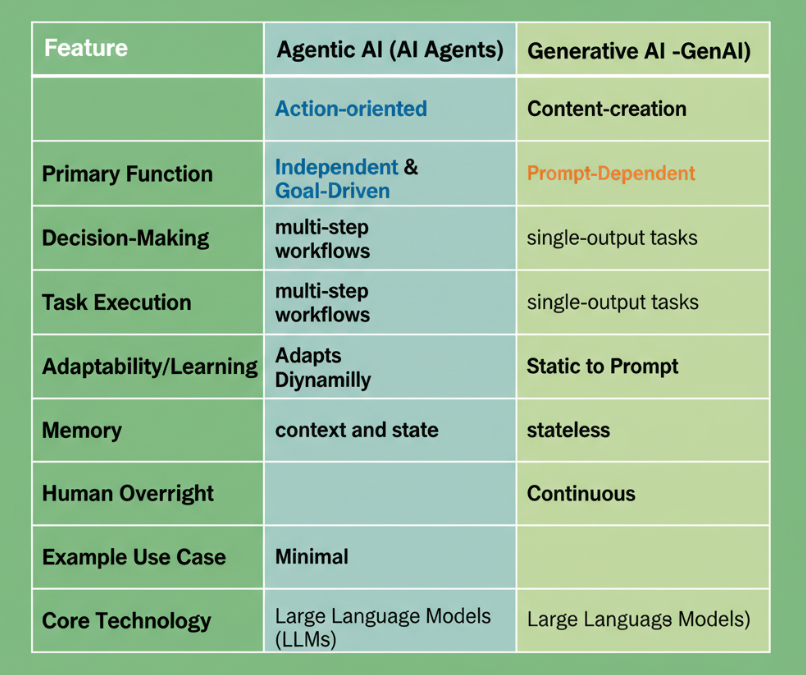
The main difference between Agentic and Generative AI is autonomy—Agentic AI acts independently, while Generative AI executes based on user prompts.
How Agentic AI is Transforming Education
Agentic AI is making dramatic improvements across many fields, including healthcare, business, customer service, and education. While some worry that AI negatively impacts education through misuse, it can be remarkably beneficial for both teachers and students when applied correctly.
Empowering Students with Personalized AI Tutoring
Many students struggle to find tutors due to financial constraints, scheduling conflicts, or difficulty finding someone who meets their individual needs. Current systems like Khanmigo and Carnegie Learning's MATHia function as AI tutors by analyzing student mistakes and providing insightful feedback on areas needing improvement.
Key Benefits:
- Quick Responses: AI tutors provide immediate answers to student questions.
- Adaptive Teaching: AI adjusts teaching methods based on student responses, noticing patterns in how students explain their concerns.
- Personalized Learning: AI analyzes data and makes autonomous decisions to address individual learning needs.
Time Management and Study Planning:
Students often struggle with time management and creating effective study plans. Agentic AI, with its ability to analyze data and make decisions autonomously, helps students develop efficient plans to achieve academic goals. The AI considers environmental factors, learning patterns, and student feedback to continuously refine its recommendations.
Supporting Teachers with Intelligent Automation
Teachers also benefit significantly from Agentic AI assistance, saving time and gaining insights into their teaching methods.
Constructive Feedback at Scale:
Teachers often take considerable time to provide constructive feedback on assignments and develop effective strategies to help students progress. Agentic AI can intervene, mitigating potential problems and providing teachers with better insights into how students learn from mistakes and make improvements.
Automated Grading:
Grading work is time-consuming. AI can accurately grade student work, freeing up significant time for teachers to focus on instruction, mentoring, and personalized student interaction.
Teaching Method Analysis:
Agentic AI can analyze teaching effectiveness, identify areas where students struggle, and suggest adjustments to instructional approaches based on data-driven insights.
Agentic AI in IT and HR Automation
Educational institutions face unique challenges in managing IT and HR operations—from onboarding new faculty and students to provisioning accounts and handling support tickets. Rezolve.ai's Agentic AI system helps educational institutions streamline these operations by automating repetitive IT and HR tasks directly within platforms like Microsoft Teams and Slack.
For educational IT departments, Rezolve.ai can:
- Automatically provision accounts for new students, faculty, and staff
- Handle password resets and access requests without human intervention
- Provide instant answers to common IT questions through intelligent knowledge search
- Route complex issues to the appropriate IT staff with full context
Learn more about automation in IT from What is a Ticketing System? and Top IT Ticketing Systems.
For educational HR departments, Rezolve.ai assists with:
- Automating onboarding workflows for new hires and students
- Delivering policy documents and capturing acknowledgments
- Answering HR-related questions instantly through conversational AI
By combining autonomous AI capabilities with human oversight, Rezolve.ai ensures that educational institutions can scale their support operations while maintaining the personal touch that students and faculty need.
The Future of Autonomous AI in 2026 and Beyond
As Agentic AI continues to evolve, its applications will expand across more industries and use cases. From education to enterprise IT, autonomous intelligence is enabling organizations to achieve more with less human intervention while maintaining quality and accuracy.
The key to successful Agentic AI adoption lies in striking the right balance between automation and human oversight. While these systems can handle complex tasks autonomously, human judgment remains essential for strategic decisions, ethical considerations, and handling edge cases.
Organizations implementing Agentic AI should focus on:
- Clearly defining goals and success metrics
- Establishing oversight mechanisms to catch errors
- Continuously training and refining AI models with feedback
- Maintaining transparency about AI decision-making processes
- Ensuring human experts remain available for complex scenarios
The future isn't about AI replacing humans—it's about AI augmenting human capabilities, handling tedious tasks autonomously, and freeing people to focus on creative, strategic, and interpersonal work that truly requires human intelligence.
Agentic AI is the next evolution of automation—balancing autonomous intelligence with human oversight to boost productivity and accuracy. Read our Blog- Rezolve.ai for Education Technology!
Key Takeaways
- Agentic AI is autonomous, making decisions independently and adapting to achieve specific goals with minimal human intervention.
- Unlike Generative AI, Agentic AI interacts dynamically with its environment and continuously improves through reinforcement learning.
- In education, Agentic AI provides personalized tutoring, adaptive learning plans, and automated grading to support both students and teachers.
- Enterprise IT benefits from Agentic AI through intelligent automation, autonomous troubleshooting, and continuous optimization.
- Rezolve.ai's multi-agent Agentic AI system automates workflows while maintaining human oversight for strategic decisions.
FAQs
1. What is Agentic AI?
Agentic AI is an autonomous form of artificial intelligence that can make decisions independently, set goals based on simple instructions, and adapt to new situations with minimal human intervention.
2. How does Agentic AI differ from Generative AI?
Agentic AI makes autonomous decisions and interacts dynamically with its environment, while Generative AI creates content based on user prompts without independent decision-making capabilities.
3. What are common applications of Agentic AI?
Common applications include workflow automation, autonomous problem-solving, predictive maintenance, resource optimization, personalized education, and intelligent IT support.
4. Is human oversight still necessary with Agentic AI?
Yes, while Agentic AI is highly autonomous, periodic human oversight is essential to catch errors, ensure alignment with goals, and handle complex situations requiring human judgment.
5. How is Agentic AI used in education?
Agentic AI powers personalized tutoring systems, adapts teaching methods to individual students, helps with time management and study planning, and automates grading to save teachers time.
6. What is Rezolve.ai's Agentic AI system?
Rezolve.ai uses a multi-agent Agentic AI framework with seven specialized agents that autonomously handle IT workflows, troubleshooting, knowledge management, escalations, security, and analytics within collaboration platforms like Teams and Slack.


.webp)

.png)










.webp)