.png)
.png)
One of the most frustrating realities of modern enterprise ITSM is not the licensing cost, the implementation timeline, or even the complexity itself. It is the simple fact that making even minor operational changes often feels disproportionately difficult.
A request that sounds straightforward on paper, such as modifying an approval flow, updating ticket routing logic, introducing a chatbot workflow, or launching a new employee service, can quickly spiral into weeks of architecture reviews, testing cycles, consultant discussions, governance approvals, and integration validation exercises.
This frustration is becoming increasingly common in 2026, especially among mid-sized organizations operating with lean internal teams and aggressive operational timelines.
Many of these cost and complexity pressures are already being discussed in the context of mid-sized ITSM environments and evolving operational models.
Click here for a deeper breakdown. Why ServiceNow feels too expensive for mid-sized IT team
Irony is hard to ignore. ITSM platforms were originally adopted to improve agility, standardize operations, and accelerate service delivery. Yet many organizations now feel trapped inside environments where operational change itself has become slow, expensive, and dependent on external expertise.
Platforms like ServiceNow remain exceptionally powerful and continue delivering enormous value for large enterprises with highly sophisticated operational requirements. However, the same enterprise-grade flexibility that makes these platforms so capable can also create significant operational drag when environments become deeply customized over time.
This challenge extends far beyond ITSM. According to McKinsey & Company, CIOs estimate that technical debt consumes between 20% and 40% of the value of their technology estate, forcing organizations to spend significant time and budget maintaining complexity instead of driving innovation. As systems become increasingly customized and interconnected, even small operational changes become rvicenowharder to execute predictably.
That growing tension between flexibility and agility is now reshaping how organizations think about ITSM altogether.
This tension is driving organizations to compare traditional ITSM models with newer AI-first alternatives.
The anatomy of configuration drag
One of the least discussed problems in enterprise ITSM is what many operational teams quietly describe as configuration drag.
Configuration drag occurs when years of workflow layering, customization, integrations, governance controls, and process modifications gradually transform an ITSM platform into an operational ecosystem so interconnected that even small adjustments become risky.
At first, customization feels empowering.
Organizations configure approval chains, automate workflows, integrate external applications, build custom reporting structures, and adapt the platform to match their operational processes. Over time, however, these individual improvements begin accumulating into highly complex dependency chains.
Eventually, a seemingly simple workflow modification may touch multiple operational layers simultaneously.
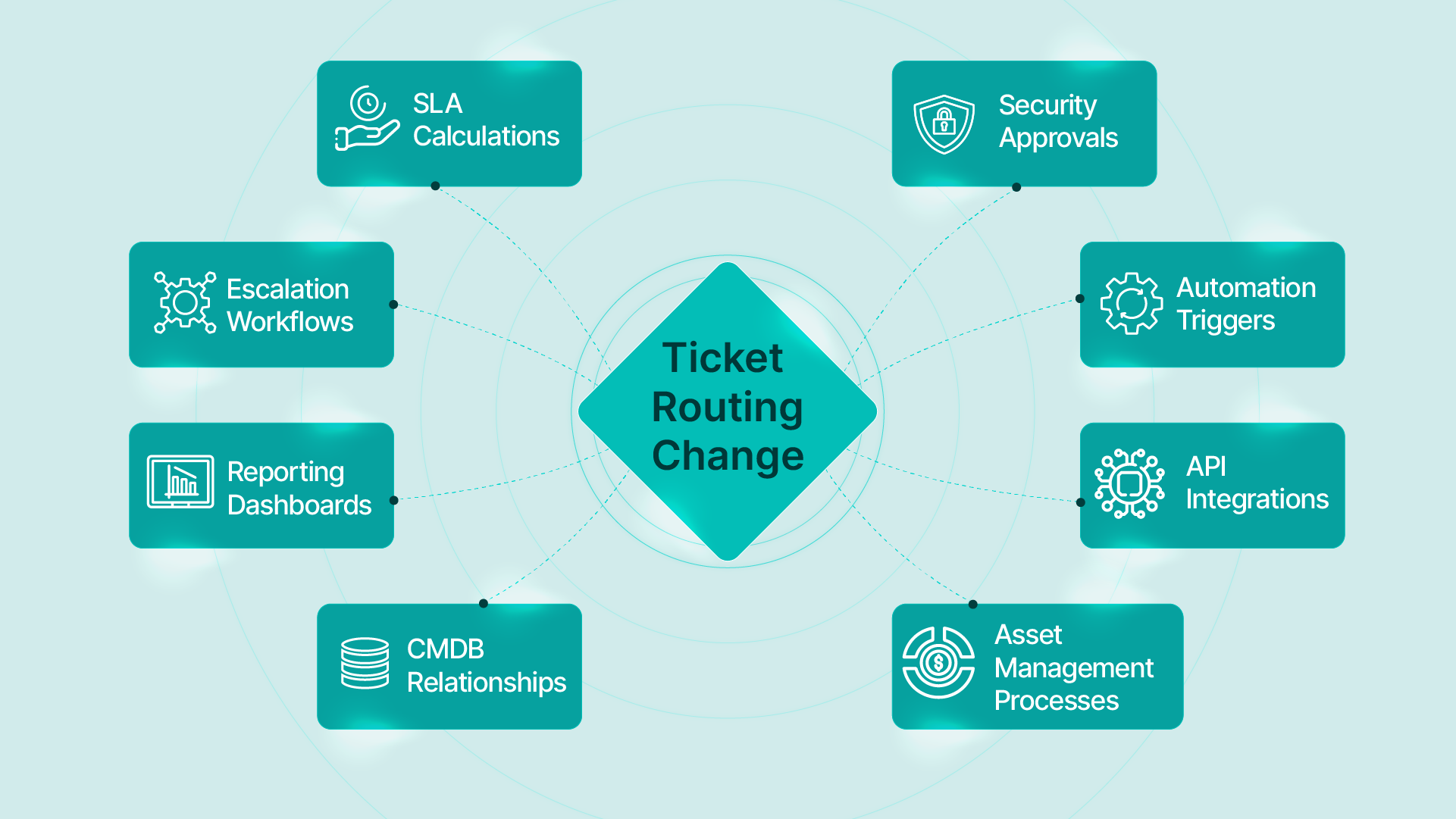
A change to ticket categorization logic, for example, could potentially affect:
- SLA calculations
- Escalation workflows
- Reporting dashboards
- CMDB relationships
- Security approvals
- Automation triggers
- API integrations
- Asset management processes
In heavily customized environments, internal teams often hesitate to make even relatively minor adjustments because the downstream consequences become difficult to predict confidently.
This is where operational agility starts slowing dramatically.
What should ideally be a quick configuration update increasingly begins resembling a software engineering exercise involves:
None of these processes are inherently unreasonable. In large enterprises, governance and operational discipline are essential. The problem emerges when accumulated platform complexity causes organizations to treat every operational adjustment as a high-risk event.
This phenomenon is particularly visible in mature ServiceNow environments where years of deep customization and cross-platform integrations have created highly sophisticated operational architectures.
Again, this is not necessarily a flaw in the platform itself. ServiceNow was intentionally designed to support enterprise-scale flexibility and extensibility. The challenge is that flexibility naturally increases operational dependency and risk exposure as environments evolve.
For mid-sized organizations, however, this operational weight can become difficult to sustain.
The financial drain of permanent retainers
One of the most underestimated costs in enterprise ITSM is not licensing but consultant dependency.
Many organizations initially approach consulting support as a temporary implementation requirement. The expectation is usually straightforward. External specialists help deploy the platform, configure workflows, migrate data, establish governance structures, and train internal administrators. Once the environment stabilizes, internal teams are expected to assume operational ownership.
In practice, that transition often remains incomplete.
As enterprise ITSM ecosystems become more customized and operationally interconnected, organizations frequently discover that internal teams lack the confidence, bandwidth, or platform specialization required to manage ongoing changes independently.
This gradually creates a permanent dependency cycle.
External consultants are no longer used only for large-scale transformations. Instead, organizations begin relying on specialized agencies and platform experts for relatively routine operational tasks such as:
Over Time, many organizations effectively place external development partners on ongoing retainers simply to maintain operational continuity. This has several consequences.
First, operational costs quietly rise year after year beyond original software licensing discussions. Consulting retainers, managed services agreements, specialist developers, and platform architects become embedded into the long-term operational budget.
Second, organizations gradually lose internal technical ownership.
Internal teams may understand business processes extremely well, yet still feel operationally dependent on external partners to execute platform changes safely. This creates a dangerous imbalance where institutional platform knowledge increasingly resides outside the organization itself.
Third, operational speed declines.
Every change request must now move through consultant availability cycles, project queues, external scoping discussions, and approval processes before implementation even begins.
For large global enterprises with massive operational budgets, this model may still be acceptable because the underlying complexity genuinely requires sophisticated governance structures.
For mid-sized organizations, however, the economics become increasingly difficult to justify.
Many IT leaders are beginning to ask a very direct question:
Why should changing a workflow require an external engineering ecosystem at all?
This question is also driving discussions around how organizations can reduce dependency on external support layers in ITSM operations. Click here to explore practical approaches to reduce ServiceNow dependency.
Paid learning curves as an operational bottleneck
Another major source of friction in traditional enterprise ITSM environments is the learning curve itself.
Modern ITSM platforms are no longer simple ticketing systems. They have evolved into expansive operational ecosystems requiring expertise across multiple technical domains simultaneously.
Administrators are often expected to understand:
- Workflow orchestration
- Integration management
- Security governance
- Low-code development
- Identity management
- Reporting frameworks
- Service mapping
- Compliance operations
Acquiring this expertise is neither quick nor inexpensive.
In many enterprise ecosystems, platform mastery increasingly depends on highly structured certification paths, formal vendor training programs, partner-led enablement, and years of operational experience.
This creates a situation where standard IT professionals may struggle to manage sophisticated environments intuitively without undergoing extensive platform-specific education.
The operational bottleneck becomes even more apparent inside mid-sized organizations where IT teams are already balancing infrastructure management, cybersecurity, SaaS administration, support operations, and digital transformation initiatives simultaneously.
Most lean IT departments simply do not have the bandwidth to maintain multiple highly specialized platform experts internally.
As a result, organizations often become trapped between two difficult options.
Either they invest heavily in expensive platform specialization and certifications, or they continue relying on external consultants indefinitely.
Neither option is particularly attractive for organizations prioritizing agility and operational efficiency.
This is one reason why the ITSM market itself is beginning to shift toward platforms emphasizing usability, simplicity, and faster operational ownership.
Organizations increasingly want systems that competent IT professionals can manage confidently without requiring years of vendor-specific specialization.
Compare Rezolve.ai vs
The modern alternative is autonomy over dependency
One of the biggest shifts happening in the ITSM industry today is the growing demand for operational autonomy.
Organizations are becoming less interested in platforms that require large consulting ecosystems to maintain agility. Instead, they are prioritizing systems that empower internal teams to build, modify, test, and deploy workflows quickly with minimal operational friction.
This is where modern AI-native platforms are beginning to change market expectations.
Rather than emphasizing deep customization layers and highly engineered operational architectures, many newer platforms focus on simplicity, conversational experiences, low administrative overhead, and rapid workflow deployment.
The philosophy is fundamentally different.
Instead of requiring organizations to adapt around the platform, modern systems increasingly aim to reduce operational dependency altogether.
Platforms such as Rezolve.ai are part of this broader market evolution. Rather than positioning ITSM as a heavily engineered workflow ecosystem requiring constant specialist oversight, these platforms focus on enabling internal teams to automate support operations rapidly through conversational AI, no-code workflow Platforms, and simplified deployment models.
The appeal is not merely lower cost but also operational freedom.
Modern IT teams increasingly want the ability to:
This shift toward agility is especially important in the AI era where operational requirements evolve constantly. Organizations can no longer afford environments where every workflow adjustment requires weeks of planning and external coordination. Operational agility itself is now becoming a competitive advantage.
Why simplicity is becoming strategically valuable
For years, enterprise software purchasing decisions focused heavily on feature depth and architectural sophistication.
The assumption was simple. More capability meant more value.
In 2026, that thinking is evolving.
Organizations are increasingly realizing that simplicity itself can create enormous strategic value when it enables faster operational execution, quicker AI adoption, lower ownership complexity, and stronger internal team empowerment.
This does not mean enterprise-grade platforms like ServiceNow are becoming irrelevant. Far from it. These platforms remain exceptionally capable and continue delivering tremendous value for highly complex global enterprises.
However, many organizations are now reassessing how much complexity genuinely aligns with their operational reality.
If a platform environment becomes so operationally layered that internal teams can no longer modify workflows confidently without external intervention, businesses naturally begin questioning whether the operational model still supports agility goals effectively.
That conversation is now accelerating across the ITSM industry.
Final thoughts
Not every ITSM change should feel like a software engineering project.
Yet many organizations increasingly operate inside environments where even relatively small workflow modifications trigger consultant involvement, governance cycles, integration analysis, testing requirements, and lengthy deployment timelines.
This is the hidden operational cost of deeply customized enterprise ecosystems.
Platforms like ServiceNow became dominant because they solved extraordinarily complex enterprise problems on a massive scale. That strength remains undeniable.
At the same time, the modern IT environment is changing rapidly. Businesses now expect faster automation, simpler AI adoption, leaner operational structures, and greater internal ownership over technology operations. That shift is reshaping what organizations value most in ITSM platforms.


.webp)

.png)









.webp)